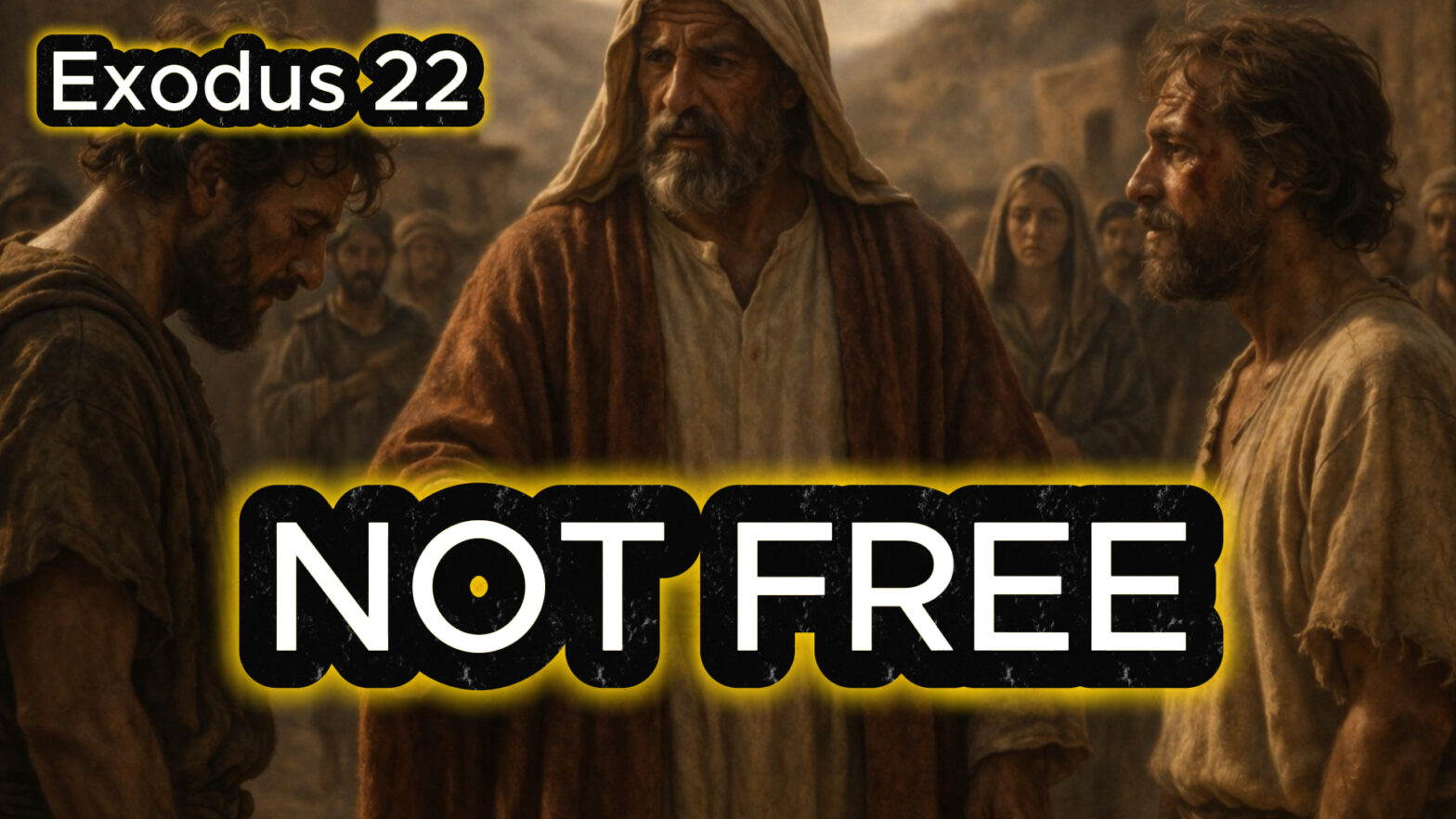
Do you believe saying “I’m sorry” is enough…
or must every wrong be fully paid for?
Exodus 22 presents a detailed expansion of God’s law, focusing on justice, restitution, and responsibility within the community of Israel. Rather than being a simple legal code, this chapter reveals how God’s kingdom begins to function in real life. It explains how wrongdoing must be addressed, how relationships must be restored, and how God’s people are called to live differently after redemption. Exodus 22 ultimately points beyond legal justice to spiritual truth, revealing humanity’s need for true atonement.
📖 What Is Exodus 22 About?
Exodus 22 describes various laws related to theft, property damage, social responsibility, and moral conduct.
If someone steals, returning what was taken is not enough.
The law requires repayment—often double or even fourfold.
At first glance, this may seem harsh.
But this principle reveals something deeper about God’s nature.
God is not only concerned with actions—
He is concerned with relationships.
When harm is done, something is broken.
Justice is not complete until restoration takes place.
This is why restitution is not minimal—
it is intentional, visible, and often costly.
🔥 Why Restitution Matters
Exodus 22 teaches that wrongdoing cannot be dismissed lightly.
A simple apology does not restore what was lost.
True justice requires responsibility.
This principle challenges modern thinking.
Today, many people separate apology from accountability.
But in God’s kingdom,
there is no separation.
To restore what was broken,
something must be given back—
and often more than what was taken.
This is not punishment for its own sake.
It is restoration.
✝️ Restitution and Repentance
However, Exodus 22 is not merely about external justice.
Sin is not only against people—
it is ultimately against God.
This means restitution alone is not enough.
Repentance must follow.
A person may repay what was stolen,
yet remain unchanged inside.
But God is not satisfied with outward correction alone.
He desires transformation of the heart.
Without repentance,
sin repeats itself.
This is why Exodus 22 points beyond law—
toward something deeper.
⚠️ The Limit of Human Justice
Here we encounter a critical truth.
No matter how much we repay,
we can never fully pay for our sin.
Human effort has limits.
Our debt before God is greater than we can measure.
This is where the law reveals its true purpose.
The law is not the solution—
it is the mirror.
It shows us our condition
and leads us to Christ.
✝️ Christ, the True Guilt Offering
Isaiah speaks of the One whose soul would become a guilt offering.
Jesus Christ fulfills what Exodus 22 ultimately points toward.
Where we could not repay,
He paid in full.
Where we could not restore,
He restored completely.
The cross is not only forgiveness—
it is the final and perfect restitution.
💔 God’s Heart for the Vulnerable
Exodus 22 also reveals God’s heart clearly.
Do not oppress the foreigner.
Do not harm the widow or the orphan.
Why?
“If they cry out to Me, I will surely hear.”
God listens closely
to those who have no one else.
This shows that God’s justice
is not cold or distant.
It is deeply personal.
🙏 Living Exodus 22 Today
Exodus 22 is not just ancient law—
it is a living principle.
We are called to:
- Take responsibility for our actions
- Restore what we have damaged
- Seek true repentance, not just outward correction
- Care for the weak and vulnerable
And above all,
to recognize our need for Christ.
✨ Conclusion
In the end, Exodus 22 teaches one central truth:
God’s kingdom is built on
justice, restoration, and love.
Not a shallow apology—
but a transformed life.
Not partial repayment—
but complete restoration.
And ultimately,
not our effort—
but Christ’s finished work.
🔗 Internal Link
👉 Explore the foundation of God’s law: Exodus 20 — The Ten Commandments Explained
👉 See how covenant begins: Exodus 19 — God’s Covenant at Sinai