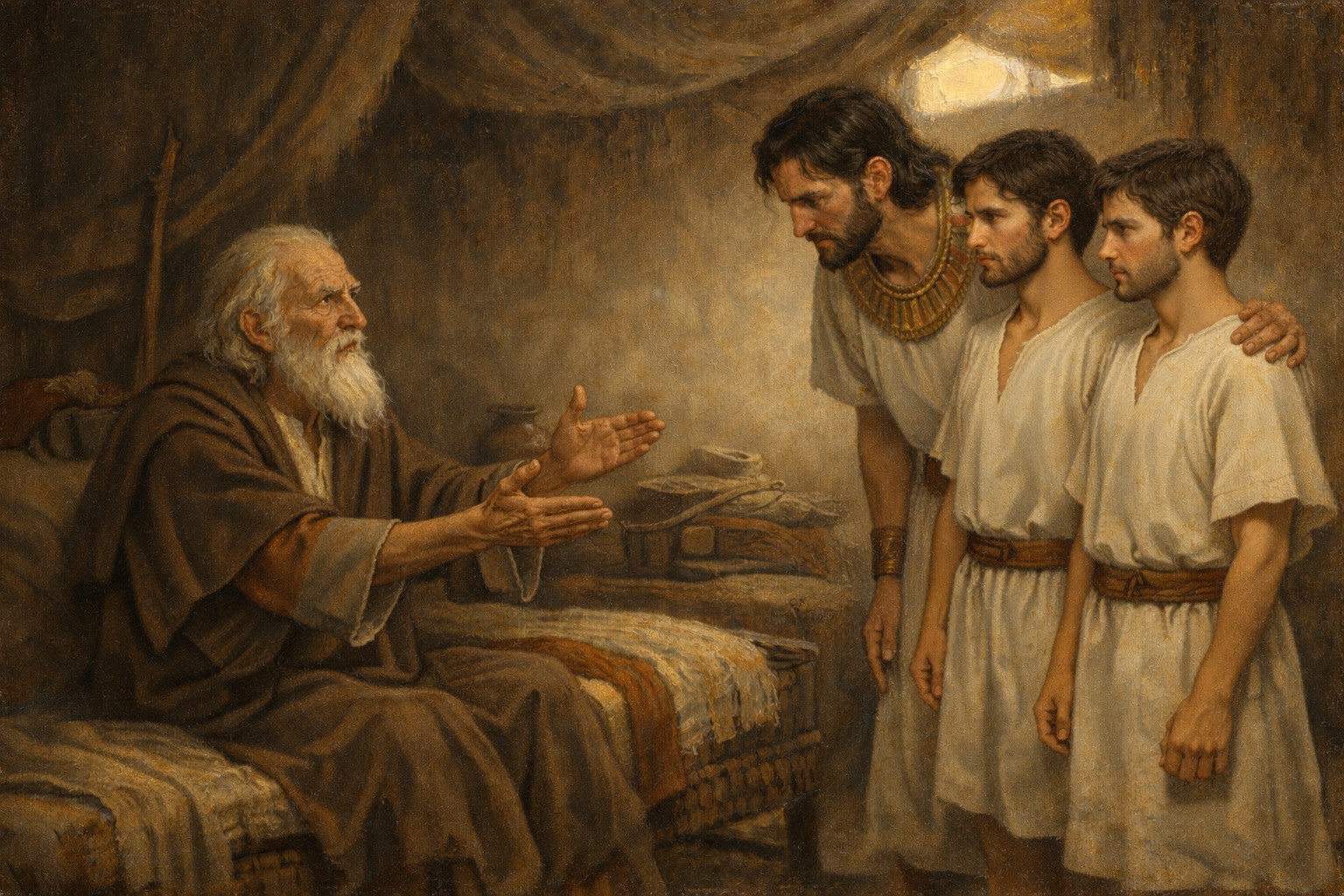
Jacob blesses Ephraim and Manasseh, showing the covenant passing to the next generation.
Genesis 48 records how Jacob, near the end of his life, adopts and blesses Joseph’s sons, Ephraim and Manasseh, formally extending the covenant line to the next generation. Recalling God’s promise at Bethel, Jacob confirms the inheritance of blessing and, crossing his hands, gives the greater blessing to the younger Ephraim over Manasseh. This chapter reveals how the covenant, blessing, and God’s sovereign choice continue across generations.
The Passing of the Covenant to the Next Generation — Genesis 48
Genesis 48 records one of the final and most tender moments in Jacob’s life. As his strength fades, Joseph comes to him with his two sons, Ephraim and Manasseh. What unfolds is not merely a family blessing scene, but a decisive act in the continuation of God’s covenant line. Jacob adopts the two boys as his own sons, granting them equal standing with Reuben and Simeon. Through this act, Joseph receives a double portion in Israel, and the covenant promise is formally extended into the next generation.
Before blessing them, Jacob recalls the God who appeared to him at Bethel and reaffirmed the promise of fruitfulness, nationhood, and land. Even in Egypt, far from Canaan, Jacob’s memory rests not on geography but on covenant. His life is framed by the promise of God, and now he consciously passes that promise forward.
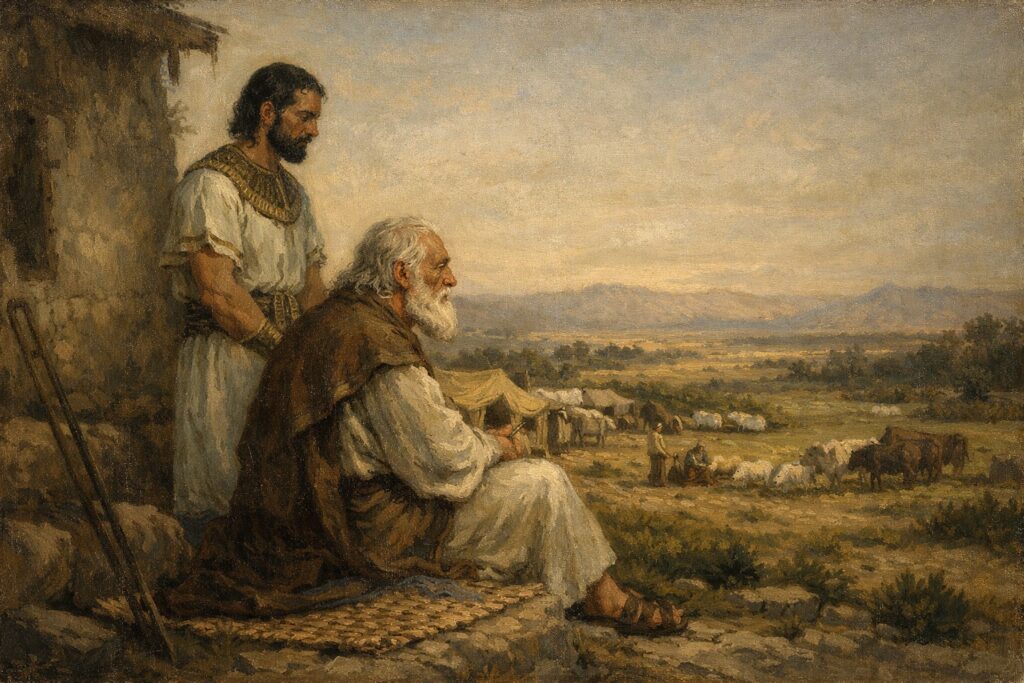
The Reversal of the Firstborn
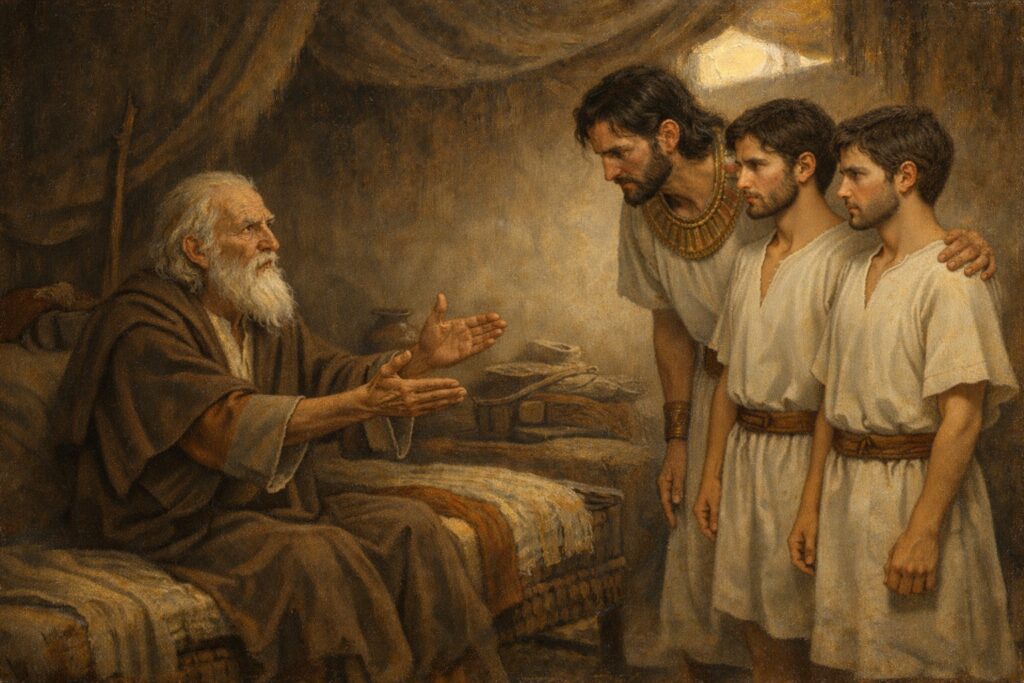
As Joseph positions his sons before Jacob, he carefully places Manasseh, the firstborn, at Jacob’s right hand and Ephraim at his left. Yet Jacob deliberately crosses his hands, placing his right hand upon Ephraim, the younger. Joseph attempts to correct what appears to be a mistake, but Jacob refuses. He understands what he is doing.
This deliberate reversal echoes a recurring biblical pattern: Isaac over Ishmael, Jacob over Esau, Joseph over his brothers. Again and again, Scripture shows that God’s purposes do not follow human expectations of birth order or natural privilege. The blessing rests where God chooses to place it. In Genesis 48, Jacob himself becomes the agent of that divine freedom, knowingly directing the greater blessing to the younger son.
Faith that Sees Beyond a Lifetime
Jacob’s blessing reaches beyond the boys themselves. He prays that the God who shepherded him all his life, and the angel who redeemed him from all evil, would bless these children and cause them to multiply greatly upon the earth. His words are filled with memory, gratitude, and hope. He sees the covenant not as something that ends with him, but as a living promise moving forward through generations.
Thus Genesis 48 becomes a passage about continuity. The covenant survives exile, distance, and death. It moves from Abraham to Isaac, from Isaac to Jacob, and now from Jacob to Joseph’s sons. Faith is not confined to one lifetime; it is entrusted, transmitted, and received.
Meditation on Genesis 48
This chapter invites us to reflect on how God’s promise continues beyond our own years. Human life is brief, yet the covenant of God endures. Jacob blesses in weakness, in old age, and outside the land of promise—yet with unshaken certainty. The future of God’s people does not depend on human strength or control, but on God’s faithful choice.
Genesis 48 therefore speaks of hope across generations. What God begins, He carries forward. The blessing we receive is never ours alone; it is meant to be handed on.
◀ Previous: Genesis 47 — Jacob Settles in Egypt
▶ Next: Genesis 49 — Jacob’s Prophetic Blessing
👉 Full Genesis Playlist
👇Full Genesis Playlist