
God reaffirms the covenant with Isaac, preserving him through conflict and blessing him in the land of promise.
Genesis 26 focuses on Isaac and demonstrates how God faithfully preserves the covenant across generations. During a time of famine, Isaac remains in the land as God instructs him and experiences extraordinary blessing despite conflict with surrounding peoples. The chapter shows repeated disputes over wells with the Philistines, yet Isaac consistently chooses peace rather than retaliation. In the midst of these tensions, God appears to Isaac and reaffirms the same covenant promises given to Abraham. Genesis 26 therefore highlights God’s faithfulness, the importance of patient endurance, and the continuation of the covenant line through Isaac.
When Conflict Feels Inevitable
When we face conflict, our instinct is often to fight back. If something is taken from us, we want to reclaim it. If we are treated unfairly, we feel compelled to defend ourselves.
Yet Scripture sometimes leads us toward a very different path — the path of winning without fighting.
Genesis 26 opens in the middle of a severe famine. Just as in Abraham’s time, the land could no longer sustain its people. For Isaac, Egypt must have seemed like the obvious solution. The Nile River promised stability even during drought.
But God intervened with a clear command:
“Do not go down to Egypt. Live in the land where I tell you to dwell.”
This was not merely about geography. It was an invitation to trust the covenant.
Faith Is Trusting God Above Circumstances
God reaffirmed the promises once given to Abraham — the land, countless descendants, and above all, His abiding presence.
At its core, faith is not about favorable conditions.
Faith is confidence that God is with us wherever He calls us to remain.
Isaac obeyed and settled in Gerar, a Philistine territory. Yet obedience did not immediately bring comfort.
As a foreigner, Isaac felt vulnerable. Fearing for his life because of Rebekah’s beauty, he claimed she was his sister. Even a man walking in God’s promise struggled with very human fear.
Still, God does not abandon those who cling to His covenant.
Through unexpected circumstances, Isaac’s household was protected, allowing him to establish roots in the land.
The Blessing That Follows Commitment
Scripture tells us that Isaac sowed in that land and reaped a hundredfold.
This detail is deeply significant.
Farming requires commitment. It reflects a decision to stay rather than flee. Isaac trusted God enough to build a future where God had placed him — and God abundantly blessed that trust.
Yet with blessing came jealousy.
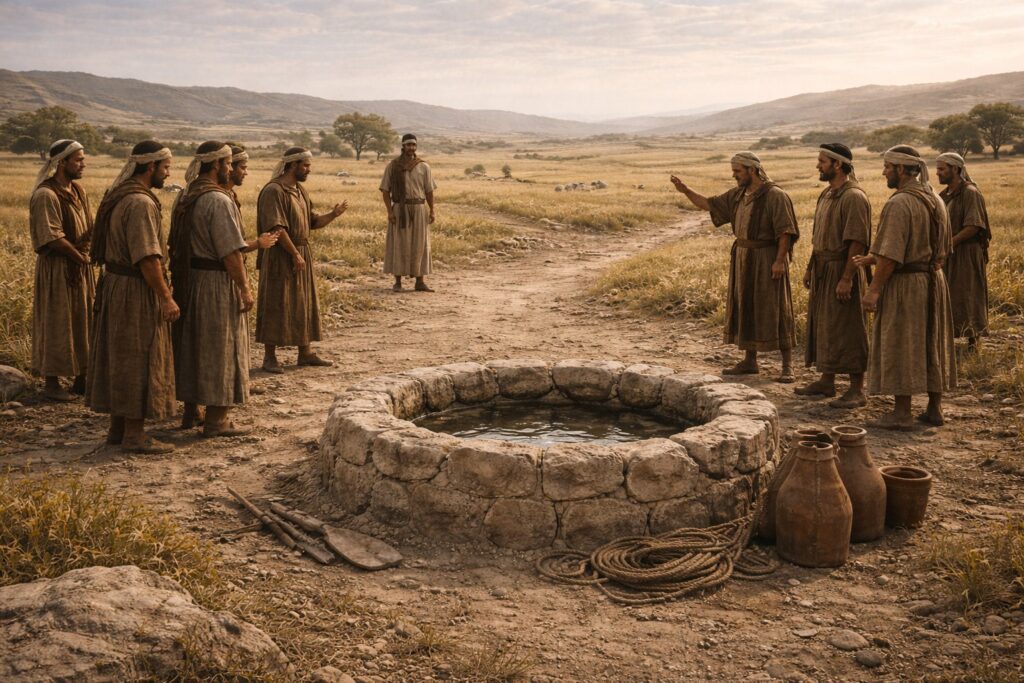
The Philistines stopped up the wells Abraham’s servants had dug, cutting off essential water sources. Eventually, Isaac was told to move away.
In that culture, wells were not merely property; they were lifelines.
Losing them meant losing security.

Choosing Peace Over Strife
At this moment, Isaac faced a defining choice.
He had the resources to fight back. Instead, he chose peace.
Again and again, he moved on and dug new wells. Each conflict left its mark — Esek, meaning “dispute,” and Sitnah, meaning “hostility.”
But Isaac refused to be drawn into endless strife.
Finally, he came to a place where no one contested the water. He named it Rehoboth, declaring:
“Now the Lord has made room for us, and we shall be fruitful in the land.”
Here lies a profound spiritual principle: we do not need to force open doors when God Himself is able to create space for us.
Winning every argument is not the same as walking in God’s promise.
True victory is found in remaining where God leads.
God Still Makes Room
Our lives are filled with tensions — in workplaces, relationships, and even within our closest circles.
Like Isaac, we are often confronted with a decision:
Will we fight, or will we trust God enough to choose peace?
Isaac’s story reminds us that gentleness is not weakness. It is an expression of deep faith.
When we refuse to be ruled by conflict, we make room for God to act on our behalf. And in His time, He brings us to our own Rehoboth — a place of freedom, growth, and unexpected provision.
Are you standing in the middle of a conflict today?
Are repeated struggles draining your strength?
Take heart.
The God who made room for Isaac is still at work. When we hold fast to His promises, He leads us into spaces far greater than anything we could secure through our own striving.
◀ Previous: Genesis 25 — Generations of Abraham
▶ Next: Genesis 27 — Jacob Receives Blessing
📖 Genesis Bible Meditation Series
Genesis Bible Meditation Playlist