
Genesis 16 records how Sarai gives Hagar to Abraham, leading to the birth of Ishmael and revealing the consequences of human attempts to fulfill God’s promise.
Genesis 16 records how Sarai gives her servant Hagar to Abram in an attempt to fulfill God’s promise through human effort. The plan leads to the birth of Ishmael and introduces tension within Abram’s household. This chapter reveals the consequences of human attempts to accomplish God’s promise by their own strategy. Yet even in this broken situation, God sees Hagar in her suffering and reveals His mercy, showing that His covenant purpose continues despite human failure.
Can silence itself become sin?
If Adam’s failure were to appear again in Abram, what would it look like?
Genesis chapter 16 reveals that the same covenant-breaking structure seen in Genesis 3 is repeated once more. The failure that began with Adam quietly reemerges in Abram, the father of faith.
Adam, as the covenant representative, failed to teach his wife clearly and failed to intervene when she was tempted. He stood by in silence as sin entered the community. Union collapsed before action was ever taken. Likewise, Abram reveals a similar failure—not through open rebellion, but through silence.
The Destruction of Union Is the Destruction of God’s Image
God is, by nature, a God of perfect union—Father, Son, and Holy Spirit. To be created in God’s image means to be created for relationship and covenantal unity. The family, especially marriage within the covenant community, is the clearest earthly reflection of that divine unity.
Adam’s silence shattered that unity, and Abram’s silence does the same. Covenant representatives are called not only to believe, but to guard the union entrusted to them.
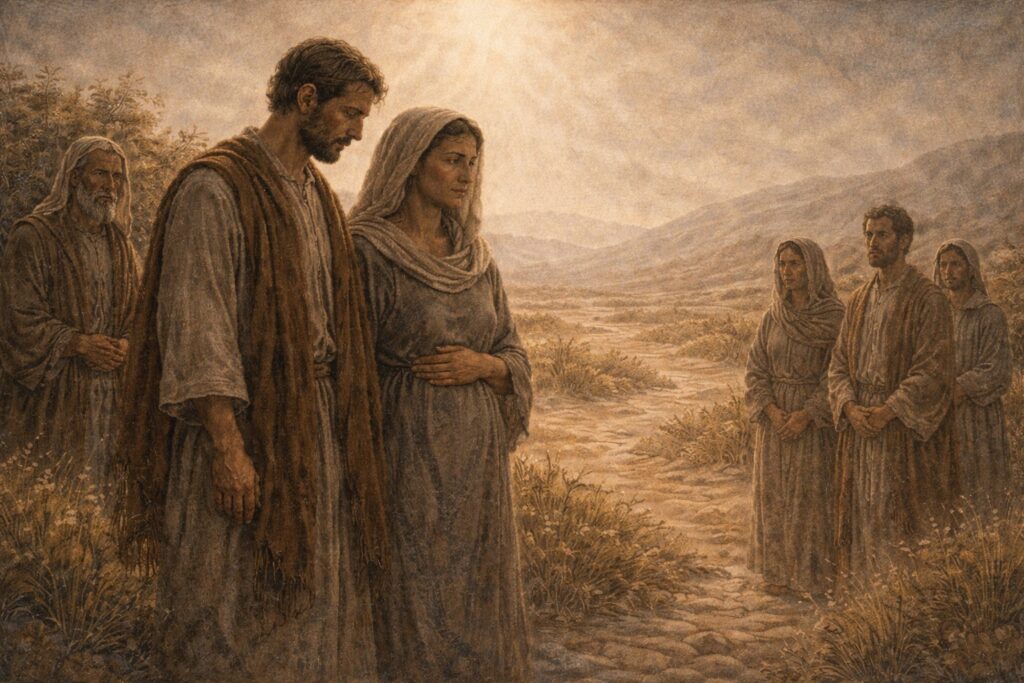
Distrusting a Promise Already Given
God had repeatedly promised Abram descendants—like the dust of the earth and the stars of the sky. That promise was always meant to be fulfilled through Sarai. God even protected her purity in Egypt, confirming His covenant.
Yet as time passed, Sarai said, “The LORD has prevented me from bearing children. Go in to my servant.”
A promise already given was treated as though it had never been granted.
At that moment, Abram should have spoken. He should have affirmed God’s promise and protected the covenant union. Instead, he remained silent. As with Adam, silence became the doorway to covenant failure.

The God Who Sees
When Hagar conceived, disorder followed. Boundaries were crossed, and conflict arose. Yet God met Hagar in the wilderness and revealed the nature of her unborn son. Confronted by the God who sees the heart, Hagar confessed, “You are the God who sees me.”
The place was named Beer-lahai-roi—the well of the Living One who sees.
Abram named the child Ishmael, “God hears.” The name itself testified that nothing had escaped God’s sight—not actions, not motives, and not silence.
Lessons We Must Hold Today
First, we must guard the unity of the covenant community. Marriage and the church are not merely relational structures, but covenantal reflections of God’s image. Love requires responsibility, not silence.
Second, God is the One who sees. He examines hearts, motives, and choices, and His examination reaches into future generations. The later conflict between Ishmael and Isaac reminds us that covenant failure carries lasting consequences.
True safety is found only when we live before the God who sees, guarding covenant unity with reverent fear.
To protect covenant unity is to protect the image of God.
May we walk faithfully before Him. Amen.
◀ Previous: Genesis 15 — God’s Covenant with Abram
▶ Next: Genesis 17 — Covenant of Circumcision
👉 Full Genesis Playlist
Genesis Bible Meditation Playlist