
Genesis 2 describes how God formed the first man and woman, established the Garden of Eden, and instituted marriage as the foundation of human life.
Genesis 2 describes the creation of Adam and Eve, the establishment of the Garden of Eden, and God’s design for marriage as the foundation of human life. This chapter reveals how humanity was created for relationship, covenant, and union, while also preparing the stage for the fall that will follow in Genesis 3. Through the formation of the woman and the first marriage, Genesis 2 points forward to the greater mystery of Christ and His church.
In Genesis 2:18, we encounter a striking declaration. After repeatedly calling His creation “good,” God speaks for the first time of something that is not good:
“It is not good for the man to be alone.”
This statement is not merely about emotional loneliness. It reveals something far deeper—God’s covenantal design for humanity. From the beginning, human life was meant to unfold within relationship, love, and union, ultimately pointing toward Jesus Christ and His church.
Adam’s Authority Over Creation
God immediately declares His intention to make “a helper suitable for him.” Yet the woman is not created right away.
Instead, God brings every animal before Adam and entrusts him with the task of naming them. In Scripture, to name is to exercise authority.
Through this process, Adam is established as steward, ruler, and king over creation. His wisdom, discernment, and creativity reveal that he truly bears the image of God.
Yet the most important outcome is not Adam’s authority over animals, but his realization of absence.
Among all living creatures, each has its pair—yet Adam stands alone.
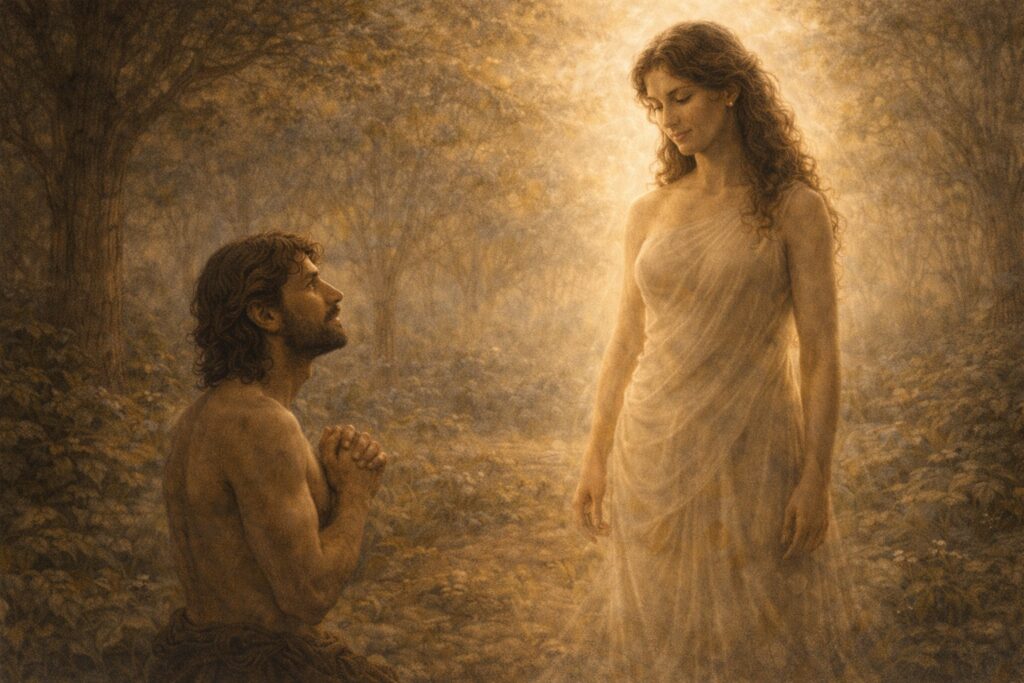
The Longing that Prepares for Love
In that moment Adam experiences a deep and unmistakable longing.
This longing is not accidental. God allows Adam to feel it because love, in its deepest form, is born from longing.
Union becomes meaningful precisely because separation was once known.
The Creation of the Woman
Then God acts in a way unique in all creation.
He causes Adam to fall into a deep sleep, takes one of his ribs, and forms the woman.
Animals were created male and female together, but the woman is formed from within the man. She shares the same essence—bone of his bones and flesh of his flesh.
A Foreshadowing of the Gospel
In Scripture, a “deep sleep” often symbolizes death.
Adam passes through a death-like sleep in order to receive his bride.
This scene quietly foreshadows the gospel. There would come another Man who would pass through real death to receive His eternal Bride.
Jesus Christ was pierced, died, and rose again, and through His sacrifice He gained the church.
The apostle Paul calls this connection “a great mystery,” referring to Christ and the church (Ephesians 5:31–32).
The First Marriage Covenant
When Adam sees the woman, he breaks into joyful confession:
“This is now bone of my bones and flesh of my flesh.”
This is not mere poetry. It is a declaration of belonging, responsibility, and covenantal union.
To name her “woman” is not an act of domination, but a commitment—to protect, to care, and to give himself for her.
Marriage therefore is not merely a partnership.
It is the union of spirit and body, reflecting the image of God Himself.
Marriage as the Beginning of God’s Kingdom
The blessings spoken in Genesis 1—fruitfulness, multiplication, filling the earth, and dominion—are meant to flow out of this holy union.
Marriage becomes the starting point of God’s kingdom on earth, where His image multiplies and His order is expressed.

The Covenant Word at the Center
Yet for this union to truly function as the foundation of God’s kingdom, one essential element was required: the covenant Word.
Adam, who directly received God’s command concerning the tree of the knowledge of good and evil, was responsible to teach it clearly and faithfully to Eve.
That command carried life itself and stood at the center of God’s order.
The Danger of Not Knowing the Word
Genesis 3:1–6 later reveals the tragic consequences of failing to know and guard the covenant.
Eve responds to the serpent with words God never spoke: “You must not touch it,” and with uncertainty: “lest you die.”
Where the Word is unclear, deception enters.
Even more serious is Adam’s silence. As the covenant representative, he fails to protect, to correct, and to speak the truth.
Both ultimately trust the serpent’s words over God’s covenant, and sin enters through doubt, desire, and disobedience.
The Enemy and the Strategy of Deception
Scripture identifies the serpent clearly: “the ancient serpent, who is the devil, who deceives the whole world.”
His strategy has never changed.
He distorts God’s Word, plants suspicion, and appeals to what appears desirable.
Humanity, created in God’s image, is always his target.
The New Covenant in Christ
But God did not abandon humanity in failure.
In His mercy, He established a new covenant through the blood of Jesus Christ.
“This is My blood of the covenant, poured out for many for the forgiveness of sins.”
To all who receive Christ and believe in His name, He gives the right to become children of God.
Living as People of the Covenant
The central command of the new covenant is love:
“As I have loved you, so you must love one another.”
Adam and Eve fell because the covenant was not fully known or faithfully upheld.
We, however, live within a perfect covenant sealed by Christ’s blood.
To know the Word accurately, to keep His commands, to resist the devil, and to make disciples—this is the calling of the people of the new covenant.
The enemy always looks for those who do not know the Word.
But the Word of the covenant is the secret of victory.
May we hold firmly to it, live in love and obedience, and walk faithfully as people of the new covenant.
Amen.
◀ Previous: Genesis 1 — Creation of the World
▶ Next: Genesis 3 — The Fall of Man
👉 Full Genesis Playlist
Genesis Bible Meditation Playlist